The Christmas STEAM Project is for my Craft and Technology class with Years 5 and 6 at PORG International School, as it’s that time of year when we need to make lovely things for the Christmas market!
Christmas STEAM Project – Basic Ideas
I divided the project into 4 broad subjects – market research, design, production and presentation. There are plenty of opportunities to show how the subjects cross over and how they work in real life.
One of the core principles underlying everything is sustainability. During discussions, I always highlight the pros and cons of material choices, including their environmental impact. Wherever possible, we recycle, upcycle and learn about the lifecycle of the materials we are using. I think staff and pupils have become used to the sight of me bin-diving the paper and cardboard recycling container by the school gates!
Market Research
To save time, I searched a wide range of blogs about craft fairs and what people actually sold. I could quickly see that smaller, cheaper items sold far better than larger, more expensive ones. It makes sense but I want to be able to show quickly that a bit of research is useful and it ties in with what they’re doing in their computing classes. I saved a list of the blog URLs and showed them on the classroom projector, just as an example of research.
Another important factor is what we can actually make with our current skills and resources. This leaves us with a short-list of candles, slime, soaps, bath bombs, tree decorations, greetings cards and wreaths for front doors.
STEAM Project – Design
Design is about much more than just the physical appearance of a product. I’m sure we’ve all experienced a product that needed more thought!
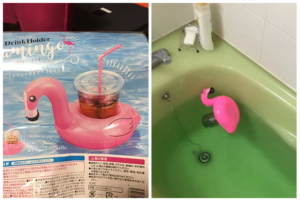
Bad design all round! Are lime green bathrooms still in anywhere?
When we discuss designs we’ll certainly talk about ‘Christmassy colours’ or whether we’ll wrap what we sell. We will also talk about how we are going to make it – the concept of design for production. Is there any way the product can be easier to make while still looking attractive? Can we identify the point where cutting material and production costs will seriously affect the finished quality?
Production
Once we have chosen what we are going to make, how are we going to make it? Luckily the Internet is full of helpful suggestions and recipes. This is a good time to look at pricing. One goal of the Christmas Market is to make a little extra money which we can add to the school budget. Although you can buy a lot of nice shiny stuff to make into Christmas gifts, I want everything in this project to be made in the most sustainable way possible. Also, buying raw materials and producing everything from scratch will help teach kids that they can often make better stuff themselves than they can buy in shops.
Breaking a project down into costs is a great practical maths lesson too. It can also be useful to show how suppliers offer bulk discounts. If you want to make a lot of something and you have kids who are particularly into maths, you can get them to try and work out the point where it’s worth buying a larger quantity of materials. With phrases like ‘mark-up’, ‘profit margin’, ‘overheads’ and ‘break-even’ in the kids’ vocabularies they can have a wider appreciation of just how much we use maths to organise our society.
I want them to experience how techniques of mass-production can affect the quality and quantity of a product as well. When we choose what to make, we will talk about how we are actually going to make it. Initially, everyone will try every stage of production but I expect that some kids will prefer specific parts of the task. Once I know who prefers what, I will let them do just that task and we will see how it affects production. A quick history lesson about Josiah Wedgewood or Henry Ford, perhaps?
Presentation
Whatever we make, it might look nicer if we have some bespoke packaging for it. Our last art project was to design a personal logo or monogram, so we might look at designing one for the class. It will have to be something quick and effective to produce though, because our time will be limited. Maybe I can use the copy of the school’s logo I have in SVG format to come up with something if we run out of time.
We will also have to give some thought to the general decor of our table so that it stands out a little from the others. Part of their homework at the beginning of the project will be to look at their favourite shops and compare them with similar shops which are not their favourite. A little guided discussion should elicit things like colours and layout. It’s a bit of a big task for Year 5 to identify what makes a shop visually attractive but you never know. These guys constantly surprise me with bright ideas!
To sum up
STEAM methodology recommends that we should have at least 3 elements of STEAM in a project. We’ve got the science of how the materails combine, whatever we make. Then there’s the art in the packaging design and presentation and maths at every stage – scaling materials from a recipe, calculating prices and dimensions of packaging and working out a timescle so that it doesn’t turrn into a last minute panic.
If any of you more experienced STEAM teachers have any ideas for improving this or any project, please feel free to leave comments below and help anyone who reads this.
Now though, it’s time to release the Christmas STEAM Project and see where it runs… Watch this space!
0 Comments